The Invisible Overhaul: How Post-Production Becomes Hollywood's Most Effective Cover Story
In the contemporary entertainment landscape, audiences and critics have become reasonably fluent in the language of production distress. Announced reshoots, directorial departures, and delayed release dates function as a loose but legible grammar of crisis. What that literacy does not account for, however, is the substantial portion of a film's reconstruction that occurs entirely out of frame — not on a soundstage, not in front of a camera, but inside the editing bay, the ADR booth, and the render farms of visual effects studios.
This is where the more sophisticated form of damage control is conducted. And because it leaves no public paper trail, it almost never gets discussed.
What the Trade Press Misses
The trades are well-equipped to report on production turbulence when it manifests visibly. A director replaced mid-shoot generates coverage. A six-week reshoot block, booked at a major facility and staffed by recognizable crew, generates coverage. These events are difficult to conceal because they involve physical locations, contracted personnel, and union paperwork that eventually surfaces.
Post-production intervention operates under an entirely different set of conditions. Automated Dialogue Replacement — commonly known as ADR — can be scheduled with minimal logistical footprint. An actor returns to a recording studio, re-voices entire scenes, and the resulting audio is integrated into the film without a single set being lit or a single camera being deployed. No location permits. No visible crew movement. No announcement.
The same logic applies to digital set extension. A scene shot practically on a modest interior set can, in post, be surrounded by an entirely fabricated environment. Walls are removed. Skylines are constructed. The physical geography of a scene can be fundamentally altered to serve a narrative that may have changed substantially since principal photography concluded. Audiences watching the final cut have no means of knowing whether the environment they are perceiving bears any meaningful resemblance to what was originally intended.
Color as Narrative Surgery
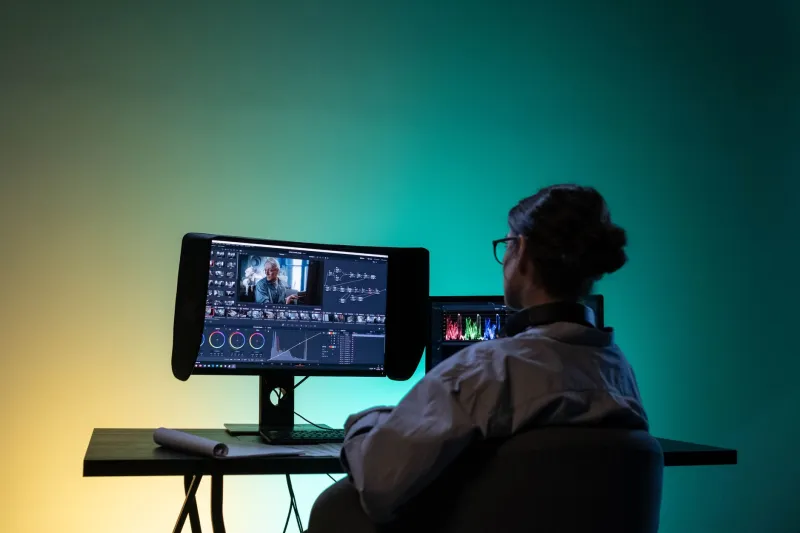
Color grading is perhaps the least discussed but most powerful instrument of post-production reconstruction. The emotional register of a film — its sense of warmth, threat, melancholy, or levity — is substantially determined in the grading suite. A production that delivered tonally inconsistent footage, perhaps owing to directorial changes or a fractured shooting schedule, can be unified through aggressive grading in ways that are largely invisible to the untrained eye.
More significantly, color grading can be used to retroactively reframe the meaning of individual scenes. A sequence shot to convey warmth and intimacy can be rendered cold and foreboding through post-production intervention. The inverse is equally achievable. When a studio determines, after test screenings, that a film's emotional arc is not landing as intended, the grading suite becomes a tool not merely of aesthetic refinement but of narrative correction.
This is not inherently problematic — post-production has always been understood as a creative phase rather than a mere technical one. What it does complicate, however, is the critical and commercial conversation that surrounds a film before its release. The version screened for early reviewers may bear a different color palette, a different emotional temperature, from the version that shipped to theaters three weeks later.
The ADR Problem and What It Reveals
Of all the invisible interventions available to a studio navigating a troubled production, ADR carries the most significant implications for a film's artistic coherence. Dialogue replacement is not simply a technical correction; it is, in many cases, a rewriting of character motivation, plot logic, and thematic intent — all conducted after the visual performance has been locked.
Actors deliver lines in a recording booth with no scene partner, no physical set, and no continuity of emotional state with the performance they are dubbing over. Even skilled performers find it difficult to fully replicate the specificity of a live on-set delivery. The resulting audio frequently carries a subtle but perceptible flatness, a quality that attentive viewers register as a vague disconnection between what they see and what they hear, even if they cannot articulate why.
When a film arrives with an unusually high proportion of ADR — something that experienced sound editors and critics can sometimes identify, though rarely publicly — it frequently signals that the dialogue as originally recorded was either technically compromised or dramatically insufficient. Both conditions point toward the same underlying conclusion: the production did not deliver what the studio needed.
The Preview Circuit and the Moving Target
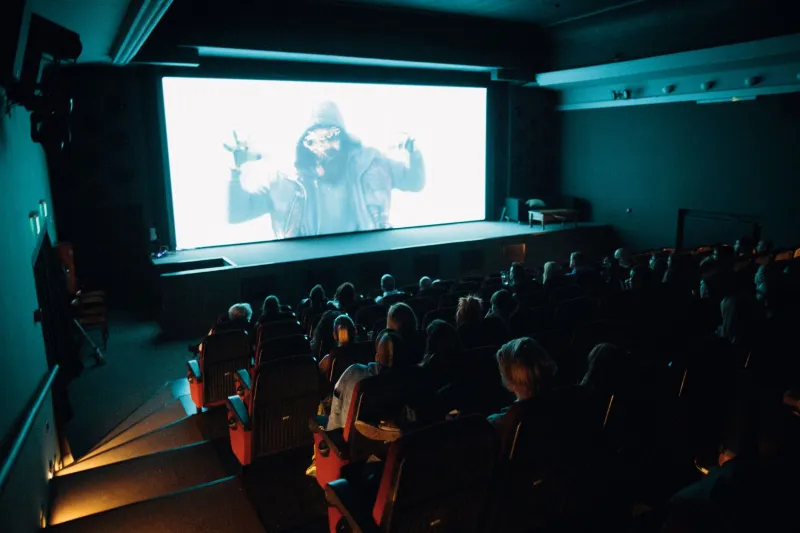
For a site committed to the relationship between early access and final product, the post-production overhaul presents a particular interpretive challenge. The version of a film screened at an industry preview event — or shared with select critics ahead of a formal embargo — may be a substantially different artifact from the one that reaches general audiences.
This is not a new phenomenon, but its scale has increased in proportion to the tools available. Digital workflows have made late-stage changes faster and cheaper than at any prior point in Hollywood history. A studio can, in theory, continue altering a film's color, dialogue, and visual architecture until days before wide release. The preview circuit, in such cases, functions less as a reliable indicator of the finished work and more as a snapshot of an intermediate state.
For critics and audiences attempting to use early commentary as a meaningful guide, this creates a structural problem. A review written based on a preview screening is implicitly a review of a version that may no longer exist by the time the film opens.
Reading the Signals That Remain
None of this renders early critical engagement meaningless. What it does require is a more sophisticated framework for interpreting the signals that post-production intervention leaves behind. A film that arrives with conspicuously uneven sound design may have undergone extensive ADR. A production whose visual environment seems inconsistent between scenes — where interior spaces feel digitally expanded in ways that do not match the film's apparent budget — may have relied heavily on post-production set construction to compensate for material shot under difficult circumstances.
The critical vocabulary for identifying these interventions remains underdeveloped, in part because the industry has little incentive to cultivate it. Studios benefit from the invisibility of post-production damage control precisely because it allows troubled productions to reach audiences without the commercial penalties that visible production chaos typically imposes.
The films that survive through these invisible means are not necessarily lesser works — some of the most formally coherent studio releases of the past decade owe their coherence to exceptional post-production rescue work. But they are works whose actual production histories remain obscured, and whose critical reception is shaped by an incomplete understanding of how they came to exist in their final form.
For anyone attempting to offer a genuine first look at what a film is and how it arrived there, that obscurity is worth taking seriously.